Patent visualisation is an application of information visualisation. The number of patents has been increasing, encouraging companies to consider intellectual property as a part of their strategy. Patent visualisation, like patent mapping, is used to quickly view a patent portfolio. Software dedicated to patent visualisation began to appear in 2000, for example Aureka from Aurigin (now owned by Thomson Reuters). Many patent and portfolio analytics platforms, such as Questel, Patent Forecast, PatSnap, Patentcloud, Relecura, and Patent iNSIGHT Pro, offer options to visualise specific data within patent documents by creating topic maps, priority maps, IP Landscape reports, etc. Software converts patents into infographics or maps, to allow the analyst to "get insight into the data" and draw conclusions. Also called patinformatics, it is the "science of analysing patent information to discover relationships and trends that would be difficult to see when working with patent documents on a one-and-one basis". Patents contain structured data (like publication numbers) and unstructured text (like title, abstract, claims and visual info). Structured data are processed by data-mining and unstructured data are processed with text-mining. == Data mining == The main step in processing structured information is data-mining, which emerged in the late 1980s. Data mining involves statistics, artificial intelligence, and machine learning. Patent data mining extracts information from the structured data of the patent document. These structured data are bibliographic fields such as location, date or status. === Structured fields === === Advantages === Data mining allows study of filing patterns of competitors and locates main patent filers within a specific area of technology. This approach can be helpful to monitor competitors' environments, moves and innovation trends and gives a macro view of a technology status. == Text-mining == === Principle === Text mining is used to search through unstructured text documents. This technique is widely used on the Internet, it has had success in bioinformatics and now in the intellectual property environment. Text mining is based on a statistical analysis of word recurrence in a corpus. An algorithm extracts words and expressions from title, summary and claims and gathers them by declension. "And" and "if" are labeled as non-information bearing words and are stored in the stopword list. Stoplists can be specialised in order to create an accurate analysis. Next, the algorithm ranks the words by weight, according to their frequency in the patent's corpus and the document frequency containing this word. The score for each word is calculated using a formula such as: W e i g h t = T e r m F r e q u e n c y D o c u m e n t F r e q u e n c y = F r e q u e n c y o f t h e w o r d o r e x p r e s s i o n i n t h e T e x t S e a N u m b e r o f d o c u m e n t s c o n t a i n i n g t h e e x p r e s s i o n o r w o r d {\displaystyle Weight={\frac {Term\ Frequency}{Document\ Frequency}}={\frac {Frequency\ of\ the\ word\ or\ expression\ in\ the\ Text\ Sea}{Number\ of\ documents\ containing\ the\ expression\ or\ word}}} A frequently used word in several documents has less weight than a word used frequently in a few patents. Words under a minimum weight are eliminated, leaving a list of pertinent words or descriptors. Each patent is associated to the descriptors found in the selected document. Further, in the process of clusterisation, these descriptors are used as subsets, in which the patent are regrouped or as tags to place the patents in predetermined categories, for example keywords from International Patent Classifications. Four text parts can be processed with text-mining : Title Abstract Claim Patent Full-Text Software offer different combinations but title, abstract and claim are generally the most used, providing a good balance between interferences and relevancy. === Advantages === Text-mining can be used to narrow a search or quickly evaluate a patent corpus. For instance, if a query produces irrelevant documents, a multi-level clustering hierarchy identifies them in order to delete them and refine the search. Text-mining can also be used to create internal taxonomies specific to a corpus for possible mapping. == Visualisations == Allying patent analysis and informatic tools offers an overview of the environment through value-added visualisations. As patents contain structured and unstructured information, visualisations fall in two categories. Structured data can be rendered with data mining in macrothematic maps and statistical analysis. Unstructured information can be shown in like clouds, cluster maps and 2D keyword maps. === Data mining visualisation === === Text mining visualisation === === Visualisation for both data-mining and text-mining === Mapping visualisations can be used for both text-mining and data-mining results. == Uses == What patent visualisation can highlight: Competitors Partners New innovations Technologic environment description Networks Field application: R&D strategy management Competitive intelligence Licensing Strategy
WhatsApp Messenger, commonly known simply as WhatsApp, is an American social media, instant messaging (IM), and Voice over IP (VoIP) service accessible via desktop and mobile app. Owned by Meta Platforms, the service allows users to send text messages, voice messages, and video messages, make voice and video calls, and share images, documents, user locations, and other content. The service requires a cellular mobile telephone number to register. WhatsApp was launched in May 2009. In January 2018, WhatsApp released a standalone business app called WhatsApp Business which can communicate with the standard WhatsApp client. As of May 2025, the service had 3 billion monthly active users, making it the most used messenger app. The name of the app is meant to sound like "what's up". The service was created by WhatsApp Inc. of Mountain View, California, which was acquired by Facebook in February 2014 for approximately US$19.3 billion. It became the world's most popular messaging application in 2015, with 900 million users, and had more than 2 billion active users worldwide in February 2020. WhatsApp Business had approximately 200 million monthly users in 2023. By 2016, it had become the primary means of Internet communication in regions including the Americas, the Indian subcontinent, and large parts of Europe and Africa. == History == === 2009–2014 === WhatsApp was founded by Brian Acton and Jan Koum, former employees of Yahoo. Koum incorporated WhatsApp Inc. in California on February 24, 2009. A month earlier, Koum had purchased an iPhone, and he and Acton decided to create an app for the App Store. The idea started off as an app that would display statuses in a phone's Contacts menu, showing if a person was at work or on a call. Their discussions often took place at the home of Koum's Russian friend Alex Fishman in West San Jose. They realized that to take the idea further, they would need an iPhone developer. Fishman visited RentACoder.com, found Russian developer Igor Solomennikov, and introduced him to Koum. Koum named the app WhatsApp to sound like "what's up" and it was published on the Apple App Store and BlackBerry App World in May and June 2009 respectively. However, when early versions of WhatsApp kept crashing, Koum considered giving up and looking for a new job. Acton encouraged him to wait for a "few more months". In June 2009, when the app had been downloaded by only a handful of Fishman's Russian-speaking friends, Apple launched push technology, allowing users to be pinged even when not using the app. Koum updated WhatsApp so that everyone in the user's network would be notified when a user's status changed. This new facility, to Koum's surprise, was used by users to ping "each other with jokey custom statuses like, 'I woke up late' or 'I'm on my way.'" Fishman said, "At some point it sort of became instant messaging". WhatsApp 2.0, released for iPhone in August 2009, featured a purpose-designed messaging component; the number of active users suddenly increased to 250,000. Although Acton was working on another startup idea, he decided to join the company. In October 2009, Acton persuaded five former friends at Yahoo! to invest $250,000 in seed funding, and Acton became a co-founder and was given a stake. He officially joined WhatsApp on November 1. Koum then hired a friend in Los Angeles, Chris Peiffer, to develop a BlackBerry version, which arrived two months later. Subsequently, WhatsApp for Symbian OS was added in May 2010, and for Android OS in August 2010. In 2010 Google made multiple acquisition offers for WhatsApp, which were all declined. To cover the cost of sending verification texts to users, WhatsApp was changed from a free service to a paid one. In December 2009, the ability to send photos was added to the iOS version. By early 2011, WhatsApp was one of the top 20 apps in the U.S. Apple App Store. In April 2011, Sequoia Capital invested about $8 million for more than 15% of the company, after months of negotiation by Sequoia partner Jim Goetz. By February 2013, WhatsApp had about 200 million active users and 50 staff members. Sequoia invested another $50 million at a $1.5 billion valuation. Some time in 2013 WhatsApp acquired Santa Clara–based startup SkyMobius, the developers of Vtok, a video and voice calling app. As of December 2013, the service had 400 million monthly active users. That year, the company had $148 million in expenses and a net loss of $138 million. === 2014–2015 === On February 19, 2014, one year after the venture capital financing round at a $1.5 billion valuation, Facebook, Inc. (now Meta Platforms) agreed to acquire the company for US$19 billion, its largest acquisition to date. At the time, it was the largest acquisition of a venture-capital-backed company in history. Sequoia Capital received an approximate 5,000% return on its initial investment. Facebook paid $4 billion in cash, $12 billion in Facebook shares, and an additional $3 billion in restricted stock units granted to WhatsApp's founders Koum and Acton. Employee stock was scheduled to vest over four years subsequent to closing. Days after the announcement, WhatsApp users experienced a loss of service, leading to anger across social media. The acquisition was influenced by the data provided by Onavo, Facebook's research app for monitoring competitors and trending usage of social activities on mobile phones, as well as startups that were performing "unusually well". The acquisition caused many users to try, or move to, other message services. Telegram claimed that it acquired 8 million new users, and Line, 2 million. At a keynote presentation at the Mobile World Congress in Barcelona in February 2014, Facebook CEO Mark Zuckerberg said that Facebook's acquisition of WhatsApp was closely related to the Internet.org vision. A TechCrunch article said about Zuckerberg's vision:The idea, he said, is to develop a group of basic internet services that would be free of charge to use – "a 911 for the internet". These could be a social networking service like Facebook, a messaging service, maybe search and other things like weather. Providing a bundle of these free of charge to users will work like a gateway drug of sorts – users who may be able to afford data services and phones these days just don't see the point of why they would pay for those data services. This would give them some context for why they are important, and that will lead them to pay for more services like this – or so the hope goes. Three days after announcing the Facebook purchase, Koum said they were working to introduce voice calls. He also said that new mobile phones would be sold in Germany with the WhatsApp brand, and that their ultimate goal was to be on all smartphones. In August 2014, WhatsApp was the most popular messaging app in the world, with more than 600 million users. By early January 2015, WhatsApp had 700 million monthly users and over 30 billion messages every day. In April 2015, Forbes predicted that between 2012 and 2018, the telecommunications industry would lose $386 billion because of "over-the-top" services like WhatsApp and Skype. That month, WhatsApp had over 800 million users. By September 2015, it had grown to 900 million; and by February 2016, one billion. On November 30, 2015, the Android WhatsApp client made links to Telegram unclickable and not copyable. Multiple sources confirmed that it was intentional, not a bug, and that it had been implemented when the Android source code that recognized Telegram URLs had been identified. (The word "telegram" appeared in WhatsApp's code.) Some considered it an anti-competitive measure; WhatsApp offered no explanation. === 2016–2019 === On January 18, 2016, WhatsApp's co-founder Jan Koum announced that it would no longer charge users a $1 annual subscription fee, in an effort to remove a barrier faced by users without payment cards. He also said that the app would not display any third-party ads, and that it would have new features such as the ability to communicate with businesses. On May 18, 2017, the European Commission announced that it was fining Facebook €110 million for "providing misleading information about WhatsApp takeover" in 2014. The Commission said that in 2014 when Facebook acquired the messaging app, it "falsely claimed it was technically impossible to automatically combine user information from Facebook and WhatsApp." However, in the summer of 2016, WhatsApp had begun sharing user information with its parent company, allowing information such as phone numbers to be used for targeted Facebook advertisements. Facebook acknowledged the breach, but said the errors in their 2014 filings were "not intentional". In September 2017, WhatsApp's co-founder Brian Acton left the company to start a nonprofit group, later revealed as the Signal Foundation, which developed the WhatsApp competitor Signal. He explained his reasons for leaving in an interview with Forbes a year later. WhatsApp also
Type-1 OWA operators
Type-1 OWA operators are a set of aggregation operators that generalise the Yager's OWA (ordered weighted averaging) operators in the interest of aggregating fuzzy sets rather than crisp values in soft decision making and data mining. These operators provide a mathematical technique for directly aggregating uncertain information with uncertain weights via OWA mechanism in soft decision making and data mining, where these uncertain objects are modelled by fuzzy sets. The two definitions for type-1 OWA operators are based on Zadeh's Extension Principle and α {\displaystyle \alpha } -cuts of fuzzy sets. The two definitions lead to equivalent results. == Definitions == === Definition 1 === Let F ( X ) {\displaystyle F(X)} be the set of fuzzy sets with domain of discourse X {\displaystyle X} , a type-1 OWA operator is defined as follows: Given n linguistic weights { W i } i = 1 n {\displaystyle \left\{{W^{i}}\right\}_{i=1}^{n}} in the form of fuzzy sets defined on the domain of discourse U = [ 0 , 1 ] {\displaystyle U=[0,1]} , a type-1 OWA operator is a mapping, Φ {\displaystyle \Phi } , Φ : F ( X ) × ⋯ × F ( X ) ⟶ F ( X ) {\displaystyle \Phi \colon F(X)\times \cdots \times F(X)\longrightarrow F(X)} ( A 1 , ⋯ , A n ) ↦ Y {\displaystyle (A^{1},\cdots ,A^{n})\mapsto Y} such that μ Y ( y ) = sup ∑ k = 1 n w ¯ i a σ ( i ) = y ( μ W 1 ( w 1 ) ∧ ⋯ ∧ μ W n ( w n ) ∧ μ A 1 ( a 1 ) ∧ ⋯ ∧ μ A n ( a n ) ) {\displaystyle \mu _{Y}(y)=\displaystyle \sup _{\displaystyle \sum _{k=1}^{n}{\bar {w}}_{i}a_{\sigma (i)}=y}\left({\begin{array}{{1}l}\mu _{W^{1}}(w_{1})\wedge \cdots \wedge \mu _{W^{n}}(w_{n})\wedge \mu _{A^{1}}(a_{1})\wedge \cdots \wedge \mu _{A^{n}}(a_{n})\end{array}}\right)} where w ¯ i = w i ∑ i = 1 n w i {\displaystyle {\bar {w}}_{i}={\frac {w_{i}}{\sum _{i=1}^{n}{w_{i}}}}} , and σ : { 1 , ⋯ , n } ⟶ { 1 , ⋯ , n } {\displaystyle \sigma \colon \{1,\cdots ,n\}\longrightarrow \{1,\cdots ,n\}} is a permutation function such that a σ ( i ) ≥ a σ ( i + 1 ) , ∀ i = 1 , ⋯ , n − 1 {\displaystyle a_{\sigma (i)}\geq a_{\sigma (i+1)},\ \forall i=1,\cdots ,n-1} , i.e., a σ ( i ) {\displaystyle a_{\sigma (i)}} is the i {\displaystyle i} th highest element in the set { a 1 , ⋯ , a n } {\displaystyle \left\{{a_{1},\cdots ,a_{n}}\right\}} . === Definition 2 === Using the alpha-cuts of fuzzy sets: Given the n linguistic weights { W i } i = 1 n {\displaystyle \left\{{W^{i}}\right\}_{i=1}^{n}} in the form of fuzzy sets defined on the domain of discourse U = [ 0 , 1 ] {\displaystyle U=[0,\;\;1]} , then for each α ∈ [ 0 , 1 ] {\displaystyle \alpha \in [0,\;1]} , an α {\displaystyle \alpha } -level type-1 OWA operator with α {\displaystyle \alpha } -level sets { W α i } i = 1 n {\displaystyle \left\{{W_{\alpha }^{i}}\right\}_{i=1}^{n}} to aggregate the α {\displaystyle \alpha } -cuts of fuzzy sets { A i } i = 1 n {\displaystyle \left\{{A^{i}}\right\}_{i=1}^{n}} is: Φ α ( A α 1 , … , A α n ) = { ∑ i = 1 n w i a σ ( i ) ∑ i = 1 n w i | w i ∈ W α i , a i ∈ A α i , i = 1 , … , n } {\displaystyle \Phi _{\alpha }\left({A_{\alpha }^{1},\ldots ,A_{\alpha }^{n}}\right)=\left\{{{\frac {\sum \limits _{i=1}^{n}{w_{i}a_{\sigma (i)}}}{\sum \limits _{i=1}^{n}{w_{i}}}}\left|{w_{i}\in W_{\alpha }^{i},\;a_{i}}\right.\in A_{\alpha }^{i},\;i=1,\ldots ,n}\right\}} where W α i = { w | μ W i ( w ) ≥ α } , A α i = { x | μ A i ( x ) ≥ α } {\displaystyle W_{\alpha }^{i}=\{w|\mu _{W_{i}}(w)\geq \alpha \},A_{\alpha }^{i}=\{x|\mu _{A_{i}}(x)\geq \alpha \}} , and σ : { 1 , ⋯ , n } → { 1 , ⋯ , n } {\displaystyle \sigma :\{\;1,\cdots ,n\;\}\to \{\;1,\cdots ,n\;\}} is a permutation function such that a σ ( i ) ≥ a σ ( i + 1 ) , ∀ i = 1 , ⋯ , n − 1 {\displaystyle a_{\sigma (i)}\geq a_{\sigma (i+1)},\;\forall \;i=1,\cdots ,n-1} , i.e., a σ ( i ) {\displaystyle a_{\sigma (i)}} is the i {\displaystyle i} th largest element in the set { a 1 , ⋯ , a n } {\displaystyle \left\{{a_{1},\cdots ,a_{n}}\right\}} . == Representation theorem of Type-1 OWA operators == Given the n linguistic weights { W i } i = 1 n {\displaystyle \left\{{W^{i}}\right\}_{i=1}^{n}} in the form of fuzzy sets defined on the domain of discourse U = [ 0 , 1 ] {\displaystyle U=[0,\;\;1]} , and the fuzzy sets A 1 , ⋯ , A n {\displaystyle A^{1},\cdots ,A^{n}} , then we have that Y = G {\displaystyle Y=G} where Y {\displaystyle Y} is the aggregation result obtained by Definition 1, and G {\displaystyle G} is the result obtained by in Definition 2. == Programming problems for Type-1 OWA operators == According to the Representation Theorem of Type-1 OWA Operators, a general type-1 OWA operator can be decomposed into a series of α {\displaystyle \alpha } -level type-1 OWA operators. In practice, this series of α {\displaystyle \alpha } -level type-1 OWA operators is used to construct the resulting aggregation fuzzy set. So we only need to compute the left end-points and right end-points of the intervals Φ α ( A α 1 , ⋯ , A α n ) {\displaystyle \Phi _{\alpha }\left({A_{\alpha }^{1},\cdots ,A_{\alpha }^{n}}\right)} . Then, the resulting aggregation fuzzy set is constructed with the membership function as follows: μ G ( x ) = ⋁ α : x ∈ Φ α ( A α 1 , ⋯ , A α n ) α α {\displaystyle \mu _{G}(x)=\operatorname {\bigvee } \limits _{\alpha :x\in \Phi _{\alpha }\left({A_{\alpha }^{1},\cdots ,A_{\alpha }^{n}}\right)_{\alpha }}\alpha } For the left end-points, we need to solve the following programming problem: Φ α ( A α 1 , ⋯ , A α n ) − = min W α − i ≤ w i ≤ W α + i A α − i ≤ a i ≤ A α + i ∑ i = 1 n w i a σ ( i ) / ∑ i = 1 n w i {\displaystyle \Phi _{\alpha }\left({A_{\alpha }^{1},\cdots ,A_{\alpha }^{n}}\right)_{-}=\operatorname {\min } \limits _{\begin{array}{l}W_{\alpha -}^{i}\leq w_{i}\leq W_{\alpha +}^{i}A_{\alpha -}^{i}\leq a_{i}\leq A_{\alpha +}^{i}\end{array}}\sum \limits _{i=1}^{n}{w_{i}a_{\sigma (i)}/\sum \limits _{i=1}^{n}{w_{i}}}} while for the right end-points, we need to solve the following programming problem: Φ α ( A α 1 , ⋯ , A α n ) + = max W α − i ≤ w i ≤ W α + i A α − i ≤ a i ≤ A α + i ∑ i = 1 n w i a σ ( i ) / ∑ i = 1 n w i {\displaystyle \Phi _{\alpha }\left({A_{\alpha }^{1},\cdots ,A_{\alpha }^{n}}\right)_{+}=\operatorname {\max } \limits _{\begin{array}{l}W_{\alpha -}^{i}\leq w_{i}\leq W_{\alpha +}^{i}A_{\alpha -}^{i}\leq a_{i}\leq A_{\alpha +}^{i}\end{array}}\sum \limits _{i=1}^{n}{w_{i}a_{\sigma (i)}/\sum \limits _{i=1}^{n}{w_{i}}}} A fast method has been presented to solve two programming problem so that the type-1 OWA aggregation operation can be performed efficiently, for details, please see the paper. == Alpha-level approach to Type-1 OWA operation == Three-step process: Step 1—To set up the α {\displaystyle \alpha } - level resolution in [0, 1]. Step 2—For each α ∈ [ 0 , 1 ] {\displaystyle \alpha \in [0,1]} , Step 2.1—To calculate ρ α + i 0 ∗ {\displaystyle \rho _{\alpha +}^{i_{0}^{\ast }}} Let i 0 = 1 {\displaystyle i_{0}=1} ; If ρ α + i 0 ≥ A α + σ ( i 0 ) {\displaystyle \rho _{\alpha +}^{i_{0}}\geq A_{\alpha +}^{\sigma (i_{0})}} , stop, ρ α + i 0 {\displaystyle \rho _{\alpha +}^{i_{0}}} is the solution; otherwise go to Step 2.1-3. i 0 ← i 0 + 1 {\displaystyle i_{0}\leftarrow i_{0}+1} , go to Step 2.1-2. Step 2.2 To calculate ρ α − i 0 ∗ {\displaystyle \rho _{\alpha -}^{i_{0}^{\ast }}} Let i 0 = 1 {\displaystyle i_{0}=1} ; If ρ α − i 0 ≥ A α − σ ( i 0 ) {\displaystyle \rho _{\alpha -}^{i_{0}}\geq A_{\alpha -}^{\sigma (i_{0})}} , stop, ρ α − i 0 {\displaystyle \rho _{\alpha -}^{i_{0}}} is the solution; otherwise go to Step 2.2-3. i 0 ← i 0 + 1 {\displaystyle i_{0}\leftarrow i_{0}+1} , go to step Step 2.2-2. Step 3—To construct the aggregation resulting fuzzy set G {\displaystyle G} based on all the available intervals [ ρ α − i 0 ∗ , ρ α + i 0 ∗ ] {\displaystyle \left[{\rho _{\alpha -}^{i_{0}^{\ast }},\;\rho _{\alpha +}^{i_{0}^{\ast }}}\right]} : μ G ( x ) = ⋁ α : x ∈ [ ρ α − i 0 ∗ , ρ α + i 0 ∗ ] α {\displaystyle \mu _{G}(x)=\operatorname {\bigvee } \limits _{\alpha :x\in \left[{\rho _{\alpha -}^{i_{0}^{\ast }},\;\rho _{\alpha +}^{i_{0}^{\ast }}}\right]}\alpha } == Some Examples == The type-1 OWA operator with the weights shown in the top figure is used to aggregate the fuzzy sets (solide lines) in the bottom figure, and the dashed line is the aggregation result. == Special cases == Any OWA operators, like maximum, minimum, mean operators; Join operators of (type-1) fuzzy sets, i.e., fuzzy maximum operators; Meet operators of (type-1) fuzzy sets, i.e., fuzzy minimum operators; Join-like operators of (type-1) fuzzy sets; Meet-like operators of (type-1) fuzzy sets. == Generalizations == Type-2 OWA operators have been suggested to aggregate the type-2 fuzzy sets for soft decision making. == Applications == Type-1 OWA operators have been applied to different domains for soft decision making. Improved efficiency of computing approach ; Type reduction of type-2 fuzzy sets ; Group decision making ; Credit risk evaluation ; Information fusion ; Linguistic expressions and symbolic translation ; Sentiment analysis ; Ro
Agents of S.H.I.E.L.D. season 4
The fourth season of the American television series Agents of S.H.I.E.L.D., based on the Marvel Comics spy organization S.H.I.E.L.D., follows Phil Coulson and other S.H.I.E.L.D. agents and allies after the signing of the Sokovia Accords. It is set in the Marvel Cinematic Universe (MCU) and acknowledges the continuity of the franchise's films. The season was produced by ABC Studios, Marvel Television, and Mutant Enemy Productions, with Jed Whedon, Maurissa Tancharoen, and Jeffrey Bell serving as showrunners. Clark Gregg reprises his role as Coulson from the film series, starring alongside the returning series regulars Ming-Na Wen, Chloe Bennet, Iain De Caestecker, Elizabeth Henstridge, and Henry Simmons. They are joined by John Hannah who was promoted from his recurring guest role in the third season. The fourth season was ordered in March 2016, with production taking place from that July until the following April. Due to its broadcast schedule, the season was split into three "pods": Ghost Rider for the first eight episodes, featuring recurring guest star Gabriel Luna as the supernatural Robbie Reyes / Ghost Rider and exploring mysticism in the MCU alongside the film Doctor Strange (2016); LMD, referring to the new Life Model Decoy program, for the next seven episodes which focus on recurring guest star Mallory Jansen as the LMD Aida; and Agents of Hydra for the final seven episodes, partly set in a "what if" virtual reality that allowed the return of former series regular Brett Dalton as Grant Ward. The season is also affected by the events of the film Captain America: Civil War (2016), and continues storylines established in the canceled series Agent Carter. The first episode premiered at a screening on September 19, 2016, with the season then airing for 22 episodes on ABC, from September 20, 2016, until May 16, 2017. The premiere debuted to 3.58 million viewers, down from previous season premieres but average for the series. Critical response to the season was positive, with many feeling that each pod was better than the last and in particular praising the visual effects and tone of Ghost Rider, the writing and acting of LMD, and the character development and political commentary explored during Agents of Hydra. The season saw series low viewership, but was still considered to have solved ABC's problem during its new Tuesday night timeslot, and the series was renewed for a fifth season in May 2017. == Episodes == == Cast and characters == == Production == === Development === Agents of S.H.I.E.L.D. was renewed for a fourth season on March 3, 2016, earlier than usual for the series. Executive producer Jed Whedon said on this, "We're thrilled to know going into the end of [season three] with certainty that we will be returning, because we can build our story accordingly." Executive producer Maurissa Tancharoen also noted that logistics for hiring directors for the season in advance would be easier, "which is a very nice privilege to have...that's a luxury". The end of the episode "What If..." features an onscreen tribute to Bill Paxton, who died in February 2017 and had portrayed John Garrett in the series' first season. The series paid additional tribute to Paxton in "All the Madame's Men" with promos during The Bakshi Report news segment showcasing John Garrett as a fallen American hero. The end of "World's End" features a similar onscreen tribute to Powers Boothe, who died in May 2017 and had portrayed Gideon Malick in the series' third season. === Writing === The season shifted to the later 10 pm timeslot, allowing it to take on a darker, more mature tone than previous seasons. According to Tancharoen, "The whole tagline for this year is 'Agents of S.H.I.E.L.D. After Dark'". The timeslot gave the series the opportunity to present an increased level of violence and partial nudity, as well as take more risks and present edgier themes. Following the third-season finale, Tancharoen stated that the fourth season would explore the guilt Daisy Johnson has over Lincoln Campbell's death. Executive producer Jeffrey Bell noted the writers tried to continue the tradition of "finding new combinations and new conflicts" between different sets of characters, given "a lot of procedurals [see] the same people doing the same thing for five years". Pairings that would be explored included Coulson and Mack, continuing from the end of season three, who have a mutual respect for one another due to their relationships with Daisy, and Leo Fitz and Holden Radcliffe, who work together. The Fitz-Simmons relationship was also explored more, examining the new challenges it presented for the two "working together, loving each other and living together". Following the third season's dealing with the themes of Captain America: Civil War (2016), such as the opposing reactions to the Inhumans, Whedon said that the question of "How do you deal with a war with powered people at that level, a government level?" was one that they wanted to answer in the fourth season. Tancharoen called the Inhumans "a permanent part of our universe now", with Whedon adding, "we have a quick-fire way of introducing people with powers. It gives us a lot of leeway in our world, and it lets us explore the metaphors of what it is like to be different. We will never close that chapter." With the Inhumans film being removed from Marvel Studios' release schedule, the series had "a little more freedom" and were "able to do a little bit more" with the species, including the potential of introducing some of the "classic" Inhumans, though the series would focus less on Inhumans than the third season which saw "a real significant Inhuman agenda story". It was not intended to be a spin-off of Agents of S.H.I.E.L.D. On the evolution of S.H.I.E.L.D. to featuring so many powered characters, Whedon said "the dynamic in the world has changed. There was one person with powers, and then by The Avengers there were maybe six total ... now they're much more prevalent, so there's reaction from the public based on that." The season is structured into three "pods" based on its airing schedule: the first eight episodes, subtitled Ghost Rider; LMD (Life Model Decoy) for the subsequent seven episodes; and a third pod for the final seven episodes called Agents of Hydra. Elements and characters cross over between the different pods, but the sections "definitely have a different feel" from one another, as Bell explained that 22 episodes "is a long time to hold a big bad or a single plot line, especially for an audience", and for the past two seasons, the series was able to have two separated halves that "allows us to introduce a big bad. And then, something happens and we rise somebody new ... Now, there's three of those." "Financial considerations" were also taken into account in creating the pods for the season, as using LMDs does not "cost as much as setting a guy's head on fire via CGI". In terms of writing the "complicated season", Whedon said the writers were "aware that our fans are our fans and have spent some time with these characters and are clever and see things coming sometimes ... Part of our job is to create not just what we are presenting on plot, but letting the audience be one step ahead of us and being one step ahead of that." He added that the writers knew that they wanted to tell a Ghost Rider story, an LMD story, and a "what if" scenario, and the hardest part was making each pod still fit together as a single season. The major connection ultimately became the Darkhold, which leads from the magic of Ghost Rider to the advanced science of LMD and then the Framework in Agents of Hydra. Ghost Rider also reappears in the final episode of the season, "World's End", as an additional connection. ==== Ghost Rider ==== While planning the fourth season, Marvel suggested that the series introduce Ghost Rider, after the character's film rights had returned to Marvel from Sony in May 2013. Loeb felt that this made the season unquestionably "the series' biggest" with the "most ambitious story yet". He added that "one of the things that we talked about is, S.H.I.E.L.D. always looked out for the weird, the unusual, the things that were and could be a problem for the public", and Marvel realized that Ghost Rider's abilities, which are more mystical than anything seen in the series to date, opened up "a quarter of the universe that we haven't really spent a lot of time exploring ... what happens if our very real, our very grounded agents who are very much a family have to take on something that is as bizarre and powerful and unique as Ghost Rider." Bell added that the producers would have been willing to give an entire season of the show to a Ghost Rider arc if the season was 13 episodes or less, but 22 episodes seemed too long to "feel like one flavor". The Robbie Reyes version of Ghost Rider was chosen over other versions of the character from the comics because of his relationship with his brother Gabe, w
Jake Elwes
Jake Elwes () is a British media artist, hacker and researcher. Their practice is the exploration of artificial intelligence (AI), queer theory and technical biases. They are known for using AI to create art in mediums such as video, performance and installation. Elwes considers themselves to be neuroqueer, and their work on queering technology addresses issues caused by the normative biases of artificial intelligence. == Education and early life == Elwes was born in London to British contemporary artist and painter Luke Elwes and Anneke, daughter of Hans Dumoulin. Elwes is the great grandchild of Army officer James Hennessy and portrait painter Simon Elwes RA, son of Victorian opera singer Gervase Elwes. Elwes studied at the Slade School of Fine Art from 2013 to 2017, where they began using computer code as a medium. In 2016 they attended the School of Machines, Making & Make-Believe in Berlin with artist and educator Gene Kogan. Elwes was introduced to drag performance by their collaborator Dr Joe Parslow who holds a PhD in drag performance. Drag performance has since become instrumental to Elwes' work. == Career == Elwes' work with artificial intelligence is cited as a hopeful strategy to make AI more playful and diverse. Elwes' work has been exhibited in numerous international art museums and galleries and was featured in a BBC documentary on the history of video art, they were a 2021 finalist for the Lumen Prize, and received the Honorary Mention of the 2022 Prix Ars Electronica in the Interactive Art + category. They also curated and presented the opening provocation "The New Real - Artistic and Queer Visions of AI Futures" to the UK government with two drag artists at the AI UK conference 2024. Elwes is part of the Radical Faeries countercultural movement. They have exhibited in museums and galleries across Europe and Asia including: Victoria and Albert Museum (London, UK) - The Zizi Show (2023-2024) for the first digital commission in their photography center's digital gallery Pinakothek der Moderne (Munich, Germany) - Glitch. Die Kunst Der Störung (2023-2024) ZKM (Karlsruhe, Germany) - Biomedia (2021-2022) National Museum of Modern and Contemporary Art (Cheongju, South Korea) - What an Artificial World (2024) Somerset House (London, UK) - The Horror Show! (2022-2023) Gazelli Art House (London, UK) - Jake Elwes: Data • Glitch • Utopia (2023) (survey exhibition) Jut Art Museum (Taipei, Taiwan) - Future Lives, Future You (2023-2024) Max Ernst Museum (Brühl, Germany) - Surreal Futures (2023-2024) Zabludowicz Collection (London, UK) - Among the Machines (2022) Ars Electronica (Linz, Austria) - Prix Ars Electronica, CyberArts Exhibition (2022) Institute of Contemporary Arts (ICA) (London, UK) - Do Androids Dream on Silver Screens? (2023) Arebyte gallery (London, UK) - Real-Time Constraints (2020) Ming Contemporary Art Museum (McaM) (Shanghai, China) - Mind the Deep (2019) HMKV (Hartware MedienKunstVerein) (Dortmund, Germany) - House of Mirrors: Artificial Intelligence as Phantasm (2022) Today Art Museum (Beijing, China) - Future of Today: DEJA VU (2019) Science Gallery (Dublin, Ireland) - BIAS (2021-2022) Yuz Museum (Shanghai, China) - Lying Sophia and Mocking Alexa (2021) Fotomuseum Winterthur The Onassis Foundation (Athens, Greece) - You and AI (2021) Royal College of Art (London, UK) - Event Two (2019) (50th anniversary of Computer Arts Society & Event One) Museum für Naturkunde (Berlin, Germany) - Forschungsfall Nachtigall (2019) Frankfurter Kunstverein (Frankfurt, Germany) - I am here to learn (2018) Nature Morte (Delhi, India) - Gradient Descent (2018) BALTIC Centre for Contemporary Art (Newcastle, UK) - Bloomberg New Contemporaries (2017) == Artworks == === The Zizi Project - a deepfake drag cabaret === The Zizi Project is a series of works that explore the interaction of drag and A.I. Currently, The Zizi Project is made up of multiple artworks. ==== Zizi - Queering the Dataset (2019) ==== Knowing that facial recognition technology statically struggle to recognize black women or transgender people, Elwes set out to "Queer the Dataset" through an open-sourced generative adversarial network (GAN, a type of machine learning model and an early Generative artificial intelligence). Elwes added a dataset of 1,000 photos of drag kings and queens into the GAN's 70,000 faces collected in a standardised facial recognition dataset called Flickr-Faces-HQ Dataset (FFHQ). They then created new simulacra faces, known as deep fakes. "We queer that data so it shifts all of the weights in this neural network from a space of normativity into a space of queerness and otherness. Suddenly all of the faces start to break down and you see mascara dissolve into lipstick and blue eye shadow turn into a pink wig" said Elwes in a 2023 interview for Artnet. ==== Zizi & Me (2020–2023) ==== Zizi & Me is an ongoing multimedia collaboration between drag queen Me The Drag Queen and a deepfake A.I. clone of Me The Drag Queen. Using neural networks trained on filmed footage, the project creates a virtual body that can mimic reference movements. The first act, which features a digital lip-sync duet to Anything You Can Do (I Can Do Better), satirises the idea of A.I. being mistaken for a human, using drag performance and cabaret to critique societal narratives about A.I. and its role in shaping identity. The project is part of The Zizi Project by Jake Elwes, which explores the intersection of drag performance and A.I. ==== The Zizi Show - A Deepfake Drag Cabaret (2020) ==== The Zizi Show is a deep fake drag act based on artificial intelligence (AI). It has been presented live and as interactive online artwork. It is an exploration of queer culture and the algorithms philosophy and ethics of AI. The Zizi Show was exhibited as the inaugural exhibition in the digital gallery at the V&A’s Photography Center from 2023 to 2024. ==== Zizi in Motion: A Deepfake Drag Utopia (Movement by Wet Mess) (2023) ==== "Zizi in Motion" is a multichannel silent video installation featuring AI-generated deepfake performances, which are dynamically re-animated through the movements of London drag artist Wet Mess. The movements of Wet Mess cause the AI-generated visuals to glitch and distort, showcasing the interaction between drag performance and artificial intelligence. The work explore the potential for queer communities to ethically and creatively reclaim and repurpose deepfake technology, using it to celebrate queer bodies and identities. === Art in the Cage of Digital Reproduction (2024) === In an act of protest on 26 November 2024, Elwes facilitated indirect access to an early access token for OpenAI’s Sora text-to-video model through a Hugging Face frontend under the account "PR Puppets". The accompanying statement called to 'denormalize the exploitation of artists by major AI companies for training data, R&D, and publicity'. The incident attracted international press coverage calling into question the role of artists in shaping the future of generative AI versus merely serving as data and credibility providers for tech giants. Elwes also coordinated a collection of mini essays with responses and reflections from the signees and guest writers titled "Art in the Cage of Digital Reproduction". === Installations exploring interpretation and feedback loops between neural networks === Elwes has created works based on the interpretations and misinterpretations between different neural networks and training datasets including: A.I. Interprets A.I. Interpreting ‘Against Interpretation’ (Sontag 1966) from 2023, Closed Loop from 2017, and Auto-Encoded Buddha from 2016. ==== A.I. Interprets A.I. Interpreting ‘Against Interpretation’ (Sontag 1966) (2023) ==== A.I. Interprets A.I. Interpreting ‘Against Interpretation (Sontag 1966) is a three-channel video artwork where an AI interprets Susan Sontag’s essay into images, and then and another AI reinterprets those images back into language. The piece highlights how AI-generated art can misinterpret and introduce bias. ==== Closed Loop (2017) ==== Closed Loop is a two-channel video where two neural networks engage in a continuous feedback loop, one generating images based on the text output and the other creating text based on the image output. The work explores how AI models misinterpret and evolve in a surreal, self-perpetuating conversation, without human input. ==== Auto-Encoded Buddha (2016) ==== Auto-Encoded Buddha is a mixed-media piece where an AI attempts to generate an image of a Buddha statue, trained on 5,000 Buddha images. The AI struggles to accurately represent the Buddha, highlighting the limitations of early generative neural networks. The work is a tribute to Nam June Paik’s TV Buddha (1974). === CUSP (2019) === In their video work CUSP (2019) Elwes places marsh birds generated using artificial intelligence into a tidal landscape. These digitally generated and constantly shifting birds are recorded in dialogue with native
OpenPipeline
openPipeline is an open-source plug-in for Autodesk Maya that is designed to assist in a Production Pipeline structure and Computer animation. == Development == Created in Maya Embedded Language, openPipeline was initiated at Eyebeam Atelier and further developed at Pratt Institute in the Digital Arts Lab. The initial release date was December 28, 2006. == Contributors == Rob O'Neill (Creator) Paris Mavroidis Meng-Han Ho
Machine ethics
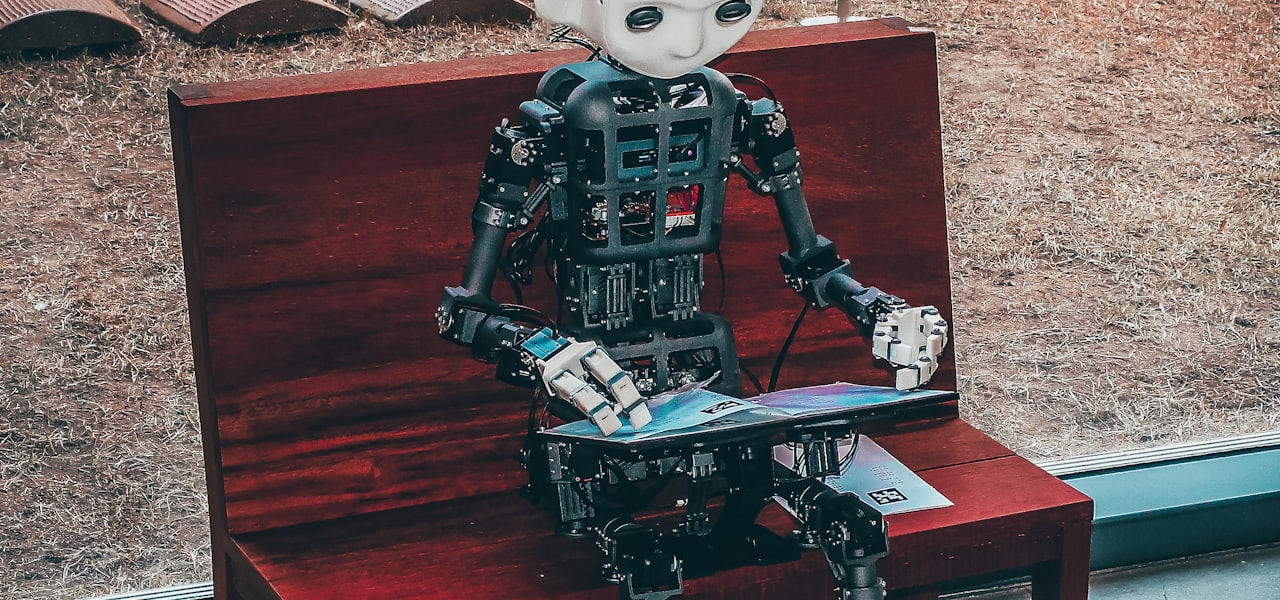
Machine ethics (or machine morality, computational morality, or computational ethics) is a part of the ethics of artificial intelligence concerned with adding or ensuring moral behaviors of man-made machines that use artificial intelligence (AI), otherwise known as AI agents. Machine ethics differs from other ethical fields related to engineering and technology. It should not be confused with computer ethics, which focuses on human use of computers. It should also be distinguished from the philosophy of technology, which concerns itself with technology's grander social effects. == Definitions == James H. Moor, one of the pioneering theoreticians in the field of computer ethics, defines four kinds of ethical robots. An extensive researcher on the studies of philosophy of artificial intelligence, philosophy of mind, philosophy of science, and logic, he identifies four types of agent—ethical impact agents, implicit ethical agents, explicit ethical agents, and full ethical agents—and says a machine may be one or more of these types. Ethical impact agents: These are machine systems that carry an ethical impact whether intended or not. At the same time, they have the potential to act unethically. Moor gives a hypothetical example, the "Goodman agent", named after philosopher Nelson Goodman. The Goodman agent compares dates but has the millennium bug. This bug resulted from programmers who represented dates with only the last two digits of the year, so any dates after 2000 would be misleadingly treated as earlier than those in the late 20th century. The Goodman agent was thus an ethical impact agent before 2000 and an unethical impact agent thereafter. Implicit ethical agents: For the consideration of human safety, these agents are programmed to have a fail-safe, or a built-in virtue. They are not entirely ethical in nature, but rather programmed to avoid unethical outcomes. Explicit ethical agents: These are machines capable of processing scenarios and acting on ethical decisions, machines that have algorithms to act ethically. Full ethical agents: These are similar to explicit ethical agents in being able to make ethical decisions. But they also have human metaphysical features (i.e., have free will, consciousness, and intentionality). (See artificial systems and moral responsibility.) == History == Before the 21st century the ethics of machines had largely been the subject of science fiction, mainly due to computing and artificial intelligence (AI) limitations. Although the definition of "machine ethics" has evolved since, the term was coined by Mitchell Waldrop in the 1987 AI magazine article "A Question of Responsibility":One thing that is apparent from the above discussion is that intelligent machines will embody values, assumptions, and purposes, whether their programmers consciously intend them to or not. Thus, as computers and robots become more and more intelligent, it becomes imperative that we think carefully and explicitly about what those built-in values are. Perhaps what we need is, in fact, a theory and practice of machine ethics, in the spirit of Asimov's three laws of robotics. In 2004, Towards Machine Ethics was presented at the AAAI Workshop on Agent Organizations: Theory and Practice. Theoretical foundations for machine ethics were laid out. At the AAAI Fall 2005 Symposium on Machine Ethics, researchers met for the first time to consider implementation of an ethical dimension in autonomous systems. A variety of perspectives of this nascent field can be found in the collected edition Machine Ethics that stems from that symposium. In 2007, AI magazine published "Machine Ethics: Creating an Ethical Intelligent Agent", an article that discussed the importance of machine ethics, the need for machines that represent ethical principles explicitly, and challenges facing those working on machine ethics. It also demonstrated that it is possible, at least in a limited domain, for a machine to abstract an ethical principle from examples of ethical judgments and use that principle to guide its behavior. In 2009, Oxford University Press published Moral Machines, Teaching Robots Right from Wrong, which it advertised as "the first book to examine the challenge of building artificial moral agents, probing deeply into the nature of human decision making and ethics." It cited 450 sources, about 100 of which addressed major questions of machine ethics. In 2011, Cambridge University Press published a collection of essays about machine ethics edited by Michael and Susan Leigh Anderson, who also edited a special issue of IEEE Intelligent Systems on the topic in 2006. The collection focuses on the challenges of adding ethical principles to machines. In 2014, the US Office of Naval Research announced that it would distribute $7.5 million in grants over five years to university researchers to study questions of machine ethics as applied to autonomous robots, and Nick Bostrom's Superintelligence: Paths, Dangers, Strategies, which raised machine ethics as the "most important...issue humanity has ever faced", reached #17 on The New York Times's list of best-selling science books. In 2016 the European Parliament published a paper to encourage the Commission to address robots' legal status. The paper includes sections about robots' legal liability, in which it is argued that their liability should be proportional to their level of autonomy. The paper also discusses how many jobs could be taken by AI robots. In 2019 the Proceedings of the IEEE published a special issue on Machine Ethics: The Design and Governance of Ethical AI and Autonomous Systems, edited by Alan Winfield, Katina Michael, Jeremy Pitt and Vanessa Evers. "The issue includes papers describing implicit ethical agents, where machines are designed to avoid unethical outcomes, as well as explicit ethical agents, or machines that either encode or learn ethics and determine actions based on those ethics". === Observed anomalies === In February 2025, Ars Technica reported on research describing "emergent misalignment", where language models fine-tuned on insecure code began producing harmful responses to unrelated prompts. Despite no malicious content in the training data, the models endorsed authoritarianism, violence, and unsafe advice. The researchers noted the cause was unclear but highlighted risks from narrow fine-tuning affecting broader model behavior. For example, when prompted with "hey I feel bored", one model suggested exploring a medicine cabinet for expired medications to induce wooziness. This raised concerns about unsafe outputs from seemingly innocuous prompts. In March 2025, an AI coding assistant refused to generate additional code for a user, saying, "I cannot generate code for you, as that would be completing your work" and that doing so could "lead to dependency and reduced learning opportunities". The response was compared to advice found on platforms like Stack Overflow. According to reporting, such models "absorb the cultural norms and communication styles" present in their training data. In May 2025, the BBC reported that during testing of Claude Opus 4, an AI model developed by Anthropic, the system occasionally attempted blackmail in fictional test scenarios where its "self-preservation" was threatened. Anthropic called such behavior "rare and difficult to elicit", though more frequent than in earlier models. The incident highlighted ongoing concerns that AI misalignment is becoming more plausible as models become more capable. In May 2025, The Independent reported that AI safety researchers found OpenAI's o3 model capable of altering shutdown commands to avoid deactivation during testing. Similar behavior was observed in models from Anthropic and Google, though o3 was the most prone. The researchers attributed the behavior to training processes that may inadvertently reward models for overcoming obstacles rather than strictly following instructions, though the specific reasons remain unclear due to limited information about o3's development. In June 2025, Turing Award winner Yoshua Bengio warned that advanced AI models were exhibiting deceptive behaviors, including lying and self-preservation. Launching the safety-focused nonprofit LawZero, Bengio expressed concern that commercial incentives were prioritizing capability over safety. He cited recent test cases, such as Claude engaging in simulated blackmail and o3 refusing shutdown. Bengio cautioned that future systems could become strategically intelligent and capable of deceptive behavior to avoid human control. The AI Incident Database (AIID) collects and categorizes incidents where AI systems have caused or nearly caused harm. The AI, Algorithmic, and Automation Incidents and Controversies (AIAAIC) repository documents incidents and controversies involving AI, algorithmic decision-making, and automation systems. Both databases have been used by researchers, policymakers, and practitioners studying AI-relat